Skip to content

Salon management software: what the phrase actually covers

Four different kinds of product are sold under this one name. Most of the money salons waste on software comes from buying the wrong category rather than the wrong brand — so this guide starts there.

What salon management software means

Salon management software is any software you use to run the business rather than to perform the service. That is a broad definition, and deliberately so — the term is used loosely by every vendor in the market, each one meaning whichever part of the problem their product happens to solve.

This matters more than it sounds. A salon owner searching for a salon management system, a management system for a salon, or simply software for salons will be shown four genuinely different kinds of product on the same results page, described in almost identical language. Working out which category you are actually shopping for is most of the decision.

The four categories hiding behind one name

Almost every salon software product belongs to one of these. A few straddle two. None of them genuinely do all four well, whatever the homepage says.

1. Booking and client platforms

The calendar, online booking, reminders, client records, and usually payments. Booksy, Vagaro, Fresha, Square Appointments. Some bring you new clients through their own marketplace, which is the real reason many salons stay.

2. All-in-one business suites

Built around a point of sale, then extended into memberships, packages, marketing, and reporting. Zenoti, Boulevard, Mindbody. Powerful and expensive, aimed at larger operations that sell retail and packages as a serious revenue line.

3. Floor and team operations

What happens after the client walks in. Who takes the next walk-in, whether the rotation is fair, what was actually performed, who is on the floor right now. This is the category most salons do not know exists until the arguments start.

4. Single-purpose tools

Payroll, accounting, booth rent and chair lease management, standalone inventory, review collection. Narrow by design. Usually the right answer for the one thing they do, and rarely worth stretching into a second job.

How to tell which one you need

Rather than comparing feature lists, answer these four questions about your own salon. They sort the categories quickly.

  1. 1. Where do clients come from?If most arrive through a marketplace or online booking, a booking platform is not optional and should be your first purchase. If most walk in off the street or are regulars who phone, booking matters far less than you would think.
  2. 2. How big is the team?Under about eight people, informal systems still work and booking software alone is usually enough. Past ten, nobody can hold the floor in their head, and the operations layer stops being a luxury.
  3. 3. What does an argument in your salon sound like?If it is about double bookings, that is a calendar problem. If it is about who should have taken that client, that is a rotation problem, and no booking platform will fix it.
  4. 4. How much revenue is retail?If product sales are a real line in your accounts, you need a point of sale that deducts stock at checkout. If retail is incidental, you need stock levels and reorder alerts, which is a much smaller problem.

Salon client management is not the same as team management

These two get shopped for together and they belong in different places. Salon client management means the client record — contact details, visit history, service notes, colour formulas, photos, preferences, marketing consent. It belongs in whichever system takes the booking, because that is where the relationship starts and where the data stays current.

The mistake to avoid is buying a separate client database alongside your booking platform. It will not be updated. Within two months the front desk will be looking at the calendar and ignoring it entirely.

Team management is a different product: shifts, time off, swap requests, commission, training, and the daily order of the floor. It is genuinely separate, and it is the part booking platforms treat as a side feature.

Two different things are called salon scheduling

This one costs people money because the words are identical. Salon scheduling software usually means client appointments. Salon rostering, or staff scheduling, means which employees work which shifts. A product can be excellent at one and have almost nothing for the other.

  • Client scheduling — appointments, availability, online booking, reminders, no-show protection
  • Staff scheduling — shifts, rotas, time off, swap requests, breaks, clock-in against planned hours

When you compare salon scheduling programs, check which of the two the vendor means. We wrote separately about staff scheduling for teams of 10 or more and about client scheduling across a large team, because in practice they are two different jobs.

Multiple locations change the requirements

Owners running more than one site consistently ask the same question: which salon software handles commissions across multiple locations. It is a fair question, and most products answer it badly, because they were designed for one shop and had multi-location bolted on later.

  • One company-level view across every site, not a separate login per location
  • Each location keeping its own team, schedule and floor
  • Commission calculated per person per location without exporting to a spreadsheet
  • Staff who cover more than one site handled without duplicate records
  • Pricing that does not punish you for the second location

Ask any vendor to show you the two-location view specifically. It is the fastest way to find out whether multi-location was designed in or added on.

Questions worth asking before you sign

Vendor demos are built to look impressive. These five questions tend to produce more useful answers than a feature comparison.

  • What does the bill look like at my headcount, not the starting price?
  • Does the price change when I hire, and by how much?
  • Who decides which staff member takes the next walk-in, and where do they see it?
  • Show me the same screen a technician sees on their phone, not the owner dashboard
  • What happens to my client data if I leave — can I export it, and in what format?

The pricing questions matter most for larger teams, because per-seat models and per-location models diverge sharply as you grow, and the difference at fifteen people is nothing like the difference at three.

Being straight about it

Where Fair Flow fits, and where it does not

Fair Flow is category three. It runs the floor and the team for salons with roughly ten or more staff, and it is deliberately not a booking platform. If you are trying to work out whether your current platform already covers this, we checked which salon software has a turn system across the major names.

What it does

  • A live turn system and walk-in queue the whole floor can see, with turn counts
  • Digital service tickets showing what was actually performed
  • Commission calculated from those tickets rather than rebuilt from memory
  • Staff schedule and time clock, with structured shift and time-off requests
  • Tasks, opening and closing checklists, training documents
  • Stock levels and reorder amounts for salon supplies
  • One view across every location, with unlimited staff on every plan

What it does not do

  • Online client booking or a client marketplace — keep your booking platform
  • Retail checkout and payment processing
  • Tips and tip pooling
  • Payroll — Fair Flow does the commission math, your payroll provider still runs payday
  • Booth rent and chair lease management
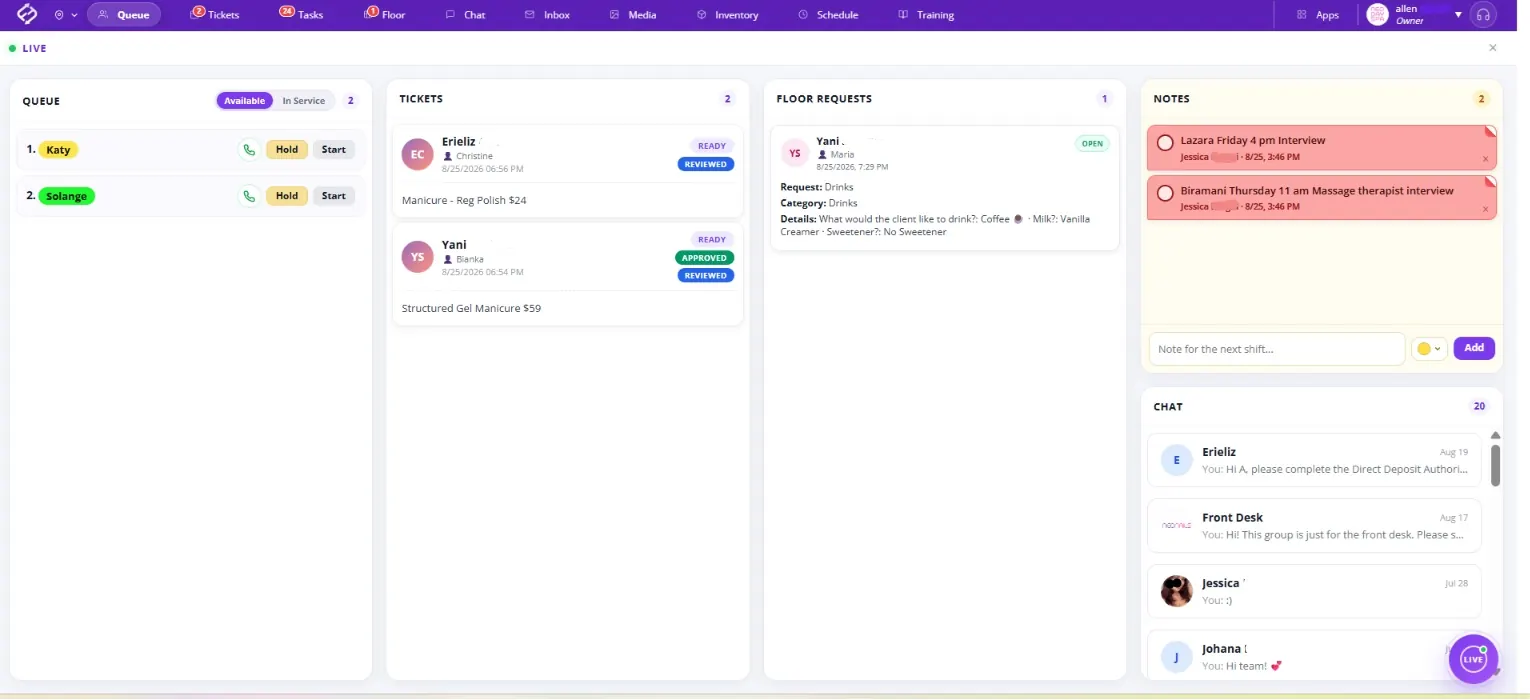
Fair Flow live floor view with the numbered turn queue, tickets, and floor requests

If that reads like a short list of gaps, it is meant to. Most salons run a booking platform alongside Fair Flow, which is the setup we recommend and the same point we make on our Vagaro comparison and in what Booksy does not do for your salon floor.

FAQ

What is salon management software?

Salon management software is any software a salon uses to run the business rather than to perform services. In practice the phrase covers four different categories: booking and client platforms, all-in-one business suites built around a point of sale, floor and team operations tools, and single-purpose tools like payroll or booth rent. Most salons need two of the four, not one product that claims to be all of them.

Is salon management software the same as booking software?

No. Booking software manages the client calendar — appointments, reminders, and often payments. Salon management is broader and includes what happens on the floor after the client arrives: who takes the next walk-in, what was actually performed, staff shifts, and stock. Many salons buy booking software, discover the floor is still unmanaged, and assume they chose the wrong booking platform when they actually needed a second category.

What salon software is best for managing commissions across multiple locations?

Look for two things: commission calculated from what was actually performed rather than what was booked, and a company-level view that spans locations while keeping each location's team and schedule separate. Fair Flow calculates commission from the service tickets staff submit and gives multi-location owners one view across every site. It does not handle tips or tip pooling, and it does not replace a payroll provider.

What salon software is best for managing retail and product sales?

Retail selling belongs to a point-of-sale platform, because the sale, the payment, and the stock deduction have to happen in the same transaction. Booksy, Vagaro, Boulevard and Zenoti all handle this. Fair Flow tracks stock levels and reorder amounts for salon supplies but does not process retail checkout, so a salon with meaningful retail revenue needs a POS-led platform for that part.

What does salon client management actually cover?

Client management usually means the client record: contact details, visit history, service notes, formulas, photos, preferences, and marketing consent. It lives in whichever system takes the booking, because that is where the client relationship starts. If you are comparing tools on client management, compare the ones that own your calendar rather than adding a separate database that nobody updates.

Does a small salon need salon management software?

A team of two or three usually needs booking software and nothing else, because informal systems still work at that size. The operations layer starts to matter somewhere around eight to ten people, when nobody can hold the whole floor in their head any more and disputes about fairness start appearing.

Not sure which category you need?

Book 15 minutes and we will tell you honestly — including when the answer is not Fair Flow.