
Salon Staff Scheduling Tips for Busy Salon Teams
The fastest way to fix a salon staff schedule is to stop building it around who wants which shift and start building it around when clients actually walk through the door. Everything else — swap requests, time-off conflicts, Saturday arguments — gets easier once coverage matches demand. Below are the specific tips that matter once your team passes ten people.
Staff scheduling is not client scheduling
These two get talked about as one thing, and they are not. Client scheduling is about appointments: who sees which client, when. Staff scheduling is about shifts: who is on the floor at all, on which days, for how many hours. A salon can have a perfectly organised appointment book and still be badly understaffed at noon on Saturday.
This article is about the second one. If the problem you are trying to solve is clients getting passed between stylists, read client scheduling for a large salon team instead.
Schedule to the demand curve, not to headcount
Most salons build a schedule that looks fair on paper — roughly the same number of people every day. Then Saturday afternoon turns into a two-hour wait while Tuesday morning has six people standing around.
Before you write next month's schedule, look at when clients actually arrived over the last four weeks, hour by hour rather than day by day. Almost every salon finds the same shape: a weekend crush concentrated in a few hours, a mid-week dead zone, and one or two evening pockets. Staff the crush heavily, staff the dead zone with your minimum viable floor, and stop treating every day as if it needs the same team.
The point is not to cut hours. It is to move them to where they earn.
Treat Saturday as a pay cheque, not a shift
In a commission salon, Saturday is not simply a busy day — it is the day people earn. Asking a commission-based technician to take Saturday off is asking them to take a pay cut, which is why time-off requests for weekends generate more conflict than anything else on the schedule.
Two things make this manageable. First, be explicit that weekend rotation is a rotation: everyone takes a turn, and the order is written down where the team can see it. Second, when you do have to say no to a weekend request, say why in terms of coverage rather than seniority. "We have three people off already that day" lands very differently from "you asked last."
Publish the schedule at least two weeks out
Salon staff have lives that require planning — childcare, second jobs, classes. A schedule published on Thursday for the week starting Monday quietly tells your team that their time outside work does not matter, and it is one of the most common reasons good technicians start looking around.
Two weeks is the practical minimum for a team of ten or more. Beyond the retention argument, it changes the kind of requests you receive: with notice, people ask for changes in advance instead of calling out on the morning of a shift.
Get shift requests out of the group chat
This is the single biggest source of scheduling chaos in salons that otherwise run well. Someone asks for a swap in the group chat at 11pm. Three people reply. Nobody confirms. On Saturday two technicians show up believing different things about who is working.
Every request that affects the schedule — time off, a swap, picking up an extra shift, coming in late, leaving early, changing a break — needs to land in one place, get an explicit approval, and then change the actual schedule. Not a message. The schedule.
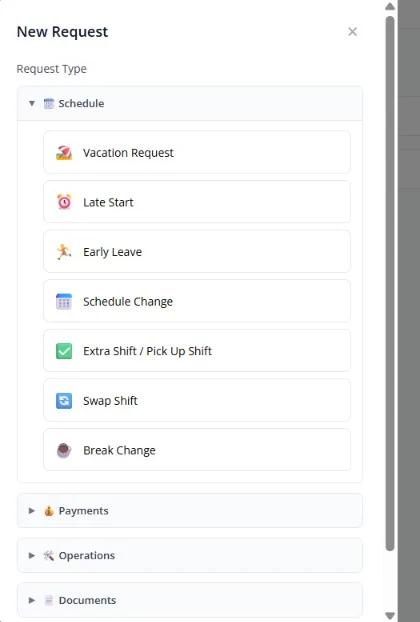
When requests are structured by type, two useful things happen. Approvals stop being a judgement call made from memory, and you get a record. At the end of a quarter you can see who has actually been picking up extra shifts and who has been swapping out of every weekend — which is the kind of thing everyone has an opinion about and nobody has evidence for. For the inbox that holds those requests, see salon employee request management.
Overstaffing quietly cuts everyone's pay
This one is specific to salons that run a walk-in rotation, and it is badly underrated. If you put ten technicians on the floor on a day that only supports six, you have not been generous. You have split the same number of clients ten ways.
On a commission floor, that shows up directly in what people take home, and it shows up fast. The complaint that reaches you will usually not be about the schedule — it will be that the turn rotation is unfair, or that somebody is being favoured. Before you go looking for a fairness problem in the rotation, check whether you simply scheduled too many people for the volume that day.
This is why the schedule and the turn system have to be looked at together. A rotation can be perfectly fair and still leave everyone underpaid if the floor is overstaffed. When that quiet stretch is a whole day, the same check is how to fill slow days at your salon without discounting the floor.
Cover specialties, not just bodies
Ten people on the floor means nothing if all of them do the same service. Salons offering nails alongside facials, waxing, or massage need coverage per specialty, not per headcount — one wax technician calling out can strand an entire category of bookings for the day.
Build the schedule by role first: confirm each service you sell has someone qualified on the floor for every hour you are open, then fill the remaining slots with general coverage. It is a small reordering of how you build the week and it prevents the most annoying category of gap.
Compare the schedule to what actually happened
The schedule says a technician worked 9 to 5. The time clock says they arrived at 9:20 and left at 4:30. Over a month, across a team of fifteen, that drift is real money and real coverage you thought you had and did not.
Once a month, compare scheduled hours against clocked hours. You are not looking to catch anyone out — you are looking for patterns. Consistent late starts on one shift usually mean the shift starts at the wrong time, not that someone is lazy. Consistent early leaving on Tuesdays usually means Tuesday is overstaffed.
For multiple locations, schedule the group, not the shop
Once you run more than one location, the schedule stops being a single sheet. Staff cover across sites, one location gets slammed while another is quiet, and a manager at each shop builds their own version with no view of the others.
The practical fix is a single view across all locations, with each manager able to see who is available group-wide before they start filling gaps. Otherwise you end up paying overtime at one site on the same afternoon another site sends someone home early.
A simple weekly routine
None of this requires a big process. A workable rhythm for a team of ten or more looks like this:
- Review last week's demand by hour, not by day
- Draft the coming two weeks against that curve, role by role
- Clear every outstanding request before publishing, not after
- Publish where the whole team sees the same version
- Once a month, compare scheduled hours to clocked hours
The goal is not a perfect schedule. It is a schedule that people trust, published early enough that they can plan around it, matched closely enough to demand that everyone earns.
Where Fair Flow fits
Fair Flow was built for salons and spas with ten or more employees. The smart schedule and time clock keep planned hours and actual hours in the same place, employee requests give every swap and time-off request a structured path instead of a group chat, and the turn system keeps the walk-in rotation fair once people are on the floor. Multi-location businesses get one view across every site.
If your schedule currently lives in a spreadsheet and your swap requests live in WhatsApp, book a demo and we will show you what it looks like in one place.