
Salon Inventory Without the Clipboard: Target Stock, Shopping Lists and Receipts
Every salon has a version of the same moment. A tech opens a cupboard mid-service and finds the box empty: gloves, files, acetone, cotton, the gel color regulars keep asking for, cleaning spray. Someone writes it on a sticky note, or says it out loud and hopes the desk hears it. By the next supply run, half of those items are remembered and half are not.
Salon inventory rarely fails because owners do not care. It fails because the routine lives in too many places: a shelf count in one person’s head, a paper list at the desk, prices on receipts in a drawer, and a shopping trip where someone tries to rebuild all of it from memory. This guide sets out a calmer salon inventory management routine: decide how much of each item you want on hand, let the missing amount become the order, shop from that list, and keep the price and receipt with the purchase.
Why salon inventory drifts
Salon stock moves in two directions at once. Some items are used up quietly during services, a few at a time, all day. Others sit untouched until the week they suddenly run out. A clipboard count can be accurate on Monday and out of date by Friday.
Three habits make the drift worse. The person who notices an empty shelf is rarely the person who buys supplies, so the message depends on memory. The supply list is usually rebuilt from scratch, so someone counts shelves by hand before every trip. And receipts sit apart from the items they paid for, so a question about current prices or monthly spend turns into a drawer search.
None of that needs a complicated warehouse system. It needs one list the whole team uses, a target for each item, and a routine that turns “we are out” into an order without a recount.
Start with one list, organized the way you shop
Write down every item the salon restocks, including the unglamorous ones: disposables, cleaning supplies, station consumables, colors, retail products, and the small extras like wine, tea or sweeteners if your salon offers them. If an item is never on the list, it will always be bought in a rush.
Group items the way the buying actually happens. Categories such as disposables and cleaning keep the list readable. Supplier or store keeps the shopping trip practical, because one trip usually covers one supplier. If you run more than one location, keep the list per location: the stock you want on hand at one salon is not the stock sitting at another.
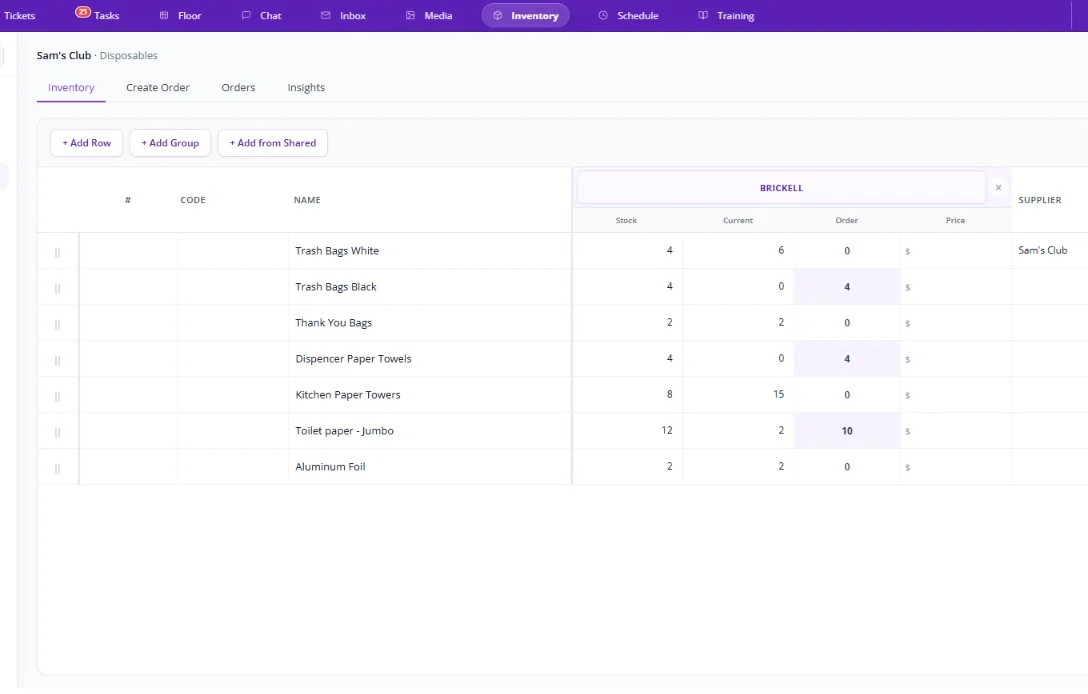
In Fair Flow, that structure is the starting point of Inventory. Lists are organized by category and supplier, for each location, so the list matches the supply run instead of forcing the supply run to match a spreadsheet.
Set a target for every item
The habit that changes everything is target stock: the number of each item you want on the shelf when you are fully stocked. The right number is different for every salon, and it comes from your own floor, not from a template.
A practical way to set it is to start with how much you use between supply trips, then add a small buffer for a busy stretch or a delayed trip. If your team goes through about three boxes of gloves in a normal week and you shop weekly, a target below three guarantees a mid-week shortage. A target a little above your normal use gives you room without filling the back room.
Gel colors are a good test. The shades clients choose every week need a target that covers a busy week, while a seasonal shade can sit at one bottle. Review targets after the first month. Items that are always short need a higher target, and items that sit untouched need a lower one. The target is a working number your salon adjusts, not a rule you set once and defend.
Let the missing amount build the order
Once every item has a target, restocking stops being a counting exercise. What you need is the gap between what you have and what you want on hand. That gap is the order.
This is the part Fair Flow handles for the supply-store routine many nail and beauty salons use. Create Order builds what is missing from your target stock, so nobody has to walk the shelves with a clipboard before a trip. The order becomes a shopping list on your phone, and the list reflects your targets rather than whoever happened to notice an empty box.
That matters on a busy floor because the signal to restock arrives early. A target turns a shortage into a planned purchase while there is still stock on the shelf. Without a target, the signal is an empty cupboard during a service, which is the worst moment to find out.
Shop the list, and record prices as you go
At the supply store, work from the list and mark what you bought. Real trips are rarely perfect. If you needed two of an item and the store had one, Fair Flow knows you are still short one, so the item does not look restocked just because it appeared on a receipt.
Record prices while you shop, item by item. Prices move, and a salon that knows what each item costs now can spot a change when it happens rather than months later. It also ends the debate about what was paid last time, because the price is written with the purchase, not remembered later.
When the trip is done, snap a photo of the receipt. Fair Flow stores it online with the purchase, so prices, receipts and spend live in one place. The drawer of receipts stops being the system.
Connect the shelf to the team
Stock problems are usually spotted at a station, not at a desk. A tech finishing a service knows the cotton is low before any weekly count does. The routine works better when that observation has somewhere to go.
In Fair Flow, Inventory is connected to the Inbox. Staff can send a missing-supply request from your salon’s supply list, so the request uses the same item names as the inventory and the order. It is the same idea as our guide to one inbox for staff requests, applied to the shelf: the observation, the item and the order stay connected.
A weekly routine that holds
- Once a week, on a quiet morning: walk the stations and cupboards once, update counts for fast-moving disposables, and let Create Order refresh what is missing.
- Before the supply trip: check the order against the shelf one last time, remove anything already bought, and confirm the list is grouped by supplier so the trip is one pass, not three.
- At the store: mark each item bought, note partial buys, and record the price as it goes in the basket.
- Back at the salon: save the receipt photo with the purchase, put stock where the list expects it, and adjust any target that clearly ran short or sat untouched.
- Once a month: look at total spend and stock health. Insights in Fair Flow show spend, forecasts and stock health, with numbers and percentages based on what you use and enter, which turns the monthly look into a short review instead of a recount of the whole salon.
Notice what is missing from that list: a full stocktake. Counts still matter for fast movers, but the weekly rhythm no longer depends on counting every shelf before anything can be ordered.
For salons with more than one location
Multi-location stock has its own trap: a group total that looks healthy while one salon is out of gloves and another has a back room full of them. Keeping items, target stock and orders per location avoids that false comfort. Each salon shops against its own shelf.
It also makes responsibility clearer. The person restocking a location works from that location’s list and supplier run, with nothing to translate from a shared spreadsheet tab first. If you are planning for several salons, see multi-location salon software.
Coming soon: count stock by voice
We're building a way for staff to tap Record in the Inventory screen and say what's on the shelf, like "We have 6 gel top coats" or "We got 2 boxes of gloves." Fair Flow will show a review screen with each item and quantity, and nothing is saved until staff tap Save.
It's in development and not available yet.
Where Fair Flow fits
Fair Flow is a salon operations platform. Inventory holds your items, target stock and orders, builds the shopping list for the supply store, tracks partial buys and prices as you shop, and stores receipt photos with each purchase. It sits next to the turn system, digital tickets, tasks, the employee Inbox, the staff schedule and the time clock, and it works alongside the tools you already use for appointments and checkout.
Pricing is per location, not per person, with unlimited staff and a 14-day trial. There are two plans: Starter at $39 a month per location, and Pro at $99 a month for the first location and $79 for each additional location. Inventory is part of Pro. See pricing, or read how Fair Flow works for a nail salon.