
Fair Turns on a Busy Walk-In Day: A Nail Salon Playbook
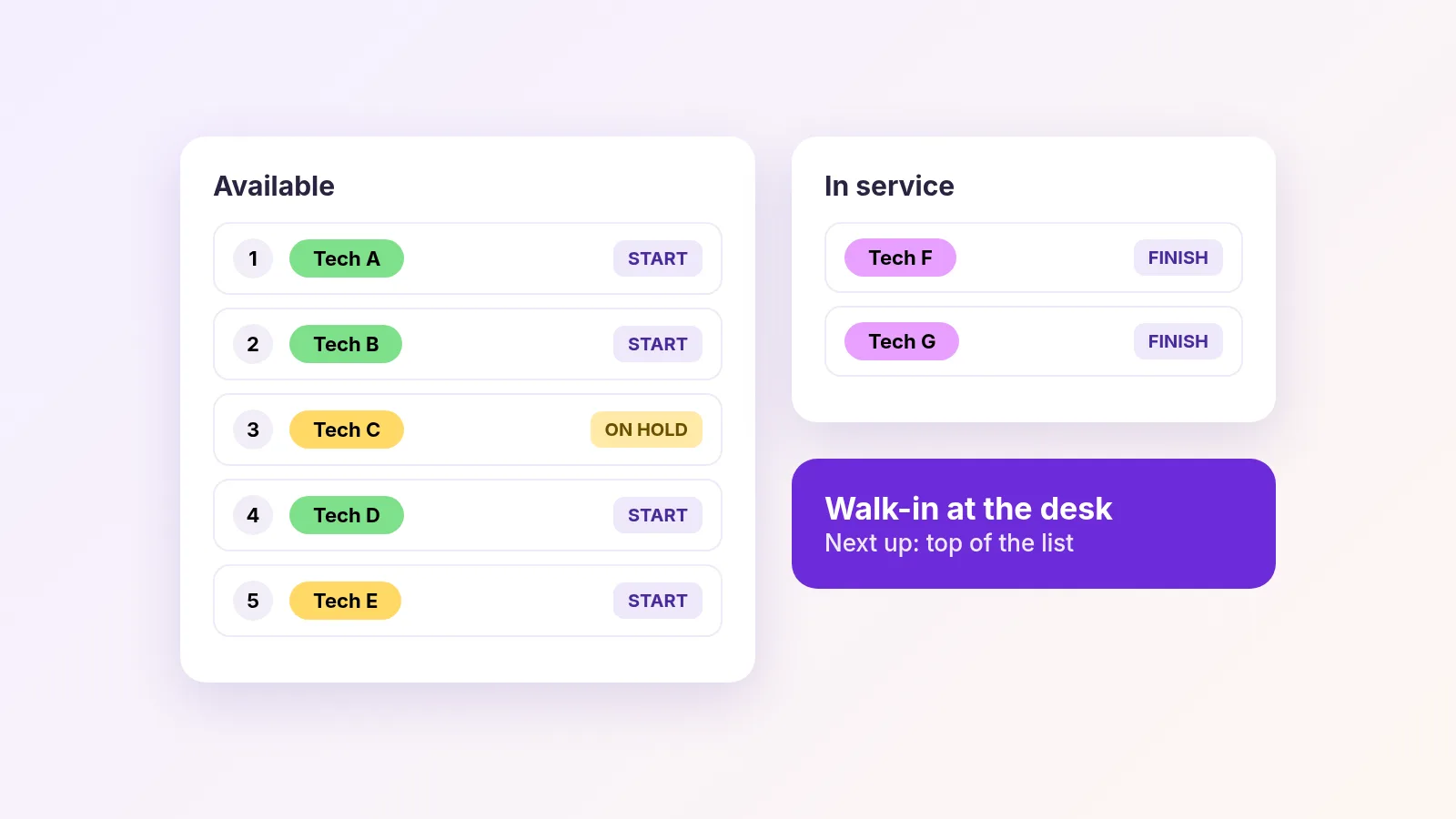
On a slow Tuesday, almost any turn system works. Three techs, a handful of walk-ins, and everyone can keep the order in their head. The system gets tested on the days when the door does not stop: a Saturday before a holiday, the week before prom, a sunny afternoon when every walk-in in the neighborhood seems to arrive at once.
That is when fairness either holds or falls apart. Not because anyone is dishonest, but because a busy floor moves faster than memory, sticky notes and shouting across the room can keep up with. This playbook walks through a high-volume walk-in day from open to close, and shows what keeps turns fair at each stage.
Why fairness breaks on your busiest days
On a heavy walk-in day, three things happen at the same time. Clients arrive in bursts, so several turns are decided within minutes of each other. Techs move constantly between the chair, the dryer, the back room and a phone call, so nobody is sure who is actually free. And the person keeping the list is also answering the phone, greeting clients and checking people out.
Each of those pressures produces the same result: a turn that someone believes was given to the wrong person. One of those per day is an annoyance. Five of them on a Saturday is how good techs start looking for another salon.
The fix is not a stricter manager. It is a turn order that everyone can see, that updates as the floor moves, and that leaves a record at the end of the day.
Before the doors open: one list, one owner
A fair day starts with a single source of truth. If the order lives on a paper sheet at the desk, a group chat and somebody’s memory, you already have three versions of the rotation before the first client walks in.
- Use one shared board. Techs join the available list as they arrive, in order, on a board the desk and the floor both see. In Fair Flow that is the Queue, a live internal view of who is available and who is in service.
- Decide who runs the desk today. Someone has to start each walk-in. Name that person before opening, so there is no debate at 11 a.m. about who had the authority to call a turn.
- Say the rules out loud once. Join in order of arrival, start moves you to in service, finish sends you to the back of the available list, and a break means hold. Short, clear, the same every day.
The morning rush: start and finish, every time
Most turn arguments come from two small gaps: a client is started but the list is not updated, or a service is finished but the tech is not sent back to the line. On a busy morning those gaps pile up quickly.
The habit that prevents them is simple. When a tech takes a walk-in, the desk presses start, and that tech moves from available to in service. When the service ends, the tech is finished and goes to the back of the available list. Nobody has to remember who was with a client, because the board shows it.
Because everyone is looking at the same board, the question at the desk changes from “whose turn is it?” to “who is at the top of the list?” The first question starts an argument. The second one has an answer anyone can read.
If your floor runs more than one kind of service, the desk can filter the board by technician type, nail, wax or facial for example, to see who on the list does the work standing at the desk. That choice stays a front-desk decision, made in plain view of the list.
Breaks, lunches and phone calls: hold, do not remove
A busy day is also a long day. Techs eat, step out for a call, or take ten minutes in the back. On a paper list this is where fairness quietly breaks: the name gets crossed out and rewritten at the bottom, or it stays at the top and the desk skips over it, or someone simply forgets.
The rule that works is hold. When a tech steps away, put them on hold. The rotation keeps moving for everyone else, and when they come back they are released into the same place they had. Their position is protected, and nobody else is stuck waiting for someone who is not on the floor.
Hold also covers the quick services that tend to cause resentment. If taking a short service would cost a tech their place, people learn to avoid short services. With hold, the tech keeps their place in the rotation, so there is no reason to turn the quick work down. Fair Flow does not use half turns. Every turn is a full turn, and hold is how a place is kept.
More on how hold fits into a fair rotation is in our guide to the rules a fair rotation has to handle.
Walk-ins versus clients who ask for someone
A busy day also brings clients who walk in asking for a specific tech. Be clear with your team about where those clients sit. The turn tracker is about walk-ins who did not ask for anyone: it decides which available tech takes the next one. A client who asks for a specific person is not part of that rotation, and your salon decides how those visits are handled, by your own policy and at the desk.
Keeping the two separate is what makes the rotation trustworthy. When everyone knows the board is for unrequested walk-ins only, a requested client never looks like a stolen turn.
The afternoon: keep the board honest
By mid-afternoon, energy drops and shortcuts creep in. A tech finishes and walks straight to the next client without the desk updating the board. Someone leaves for the day and stays on the available list. These are small, but they are exactly the moments a tech later points to when they feel skipped.
- Do a quick board check every hour or so: is everyone marked available actually on the floor?
- When the order really does need to change, let a manager reorder it on the board, not by quietly calling someone out of turn.
- When a tech leaves for the day, take them off the list right away, so the next walk-in does not wait on someone who is gone.
End of day: settle it with turn counts
The most useful part of a digital turn system often shows up after closing. Fair Flow keeps a turn count for every tech and a history you can look back through by day. When someone feels the rotation was uneven, you can open the record together instead of arguing from memory.
That changes the conversation. “I feel like I got fewer walk-ins” becomes a number you can look at. Sometimes the number shows a real problem, and you fix it. Often it shows the day was more even than it felt, and the complaint ends there. Either way, the tech was heard and the answer was the same for everyone.
What your team gets out of it
- Less arguing at the desk. The order is visible, so there is nothing to dispute in the moment.
- Techs who trust the rotation. Fair turns on the busiest days are a big part of why good techs stay.
- A calmer front desk. The desk starts and finishes turns instead of refereeing them.
- Walk-ins served faster. When everyone can see who is free, a client is not left waiting while a chair sits empty.
- A record for every day. Turn counts and history replace “I think” with “here it is.”
Where Fair Flow fits
Fair Flow is a salon operations platform. Its nail salon turn tracker gives the whole team one live board for walk-ins, with start, finish, hold, turn counts and history, next to digital tickets, tasks, the employee inbox, schedules and the time clock. It is not booking, POS, payroll or payments software, so you keep the tools you already use for appointments and checkout.
The queue is internal: clients do not see their place in line. Pricing is per location, not per person: $99 a month for the first location and $79 for each additional location, with unlimited staff. If you want to see how the walk-in side works in practice, start with salon queue management, or read which kinds of salon software actually track the turn.